How to Fix Plantation Shutter Tilt Rods at Home
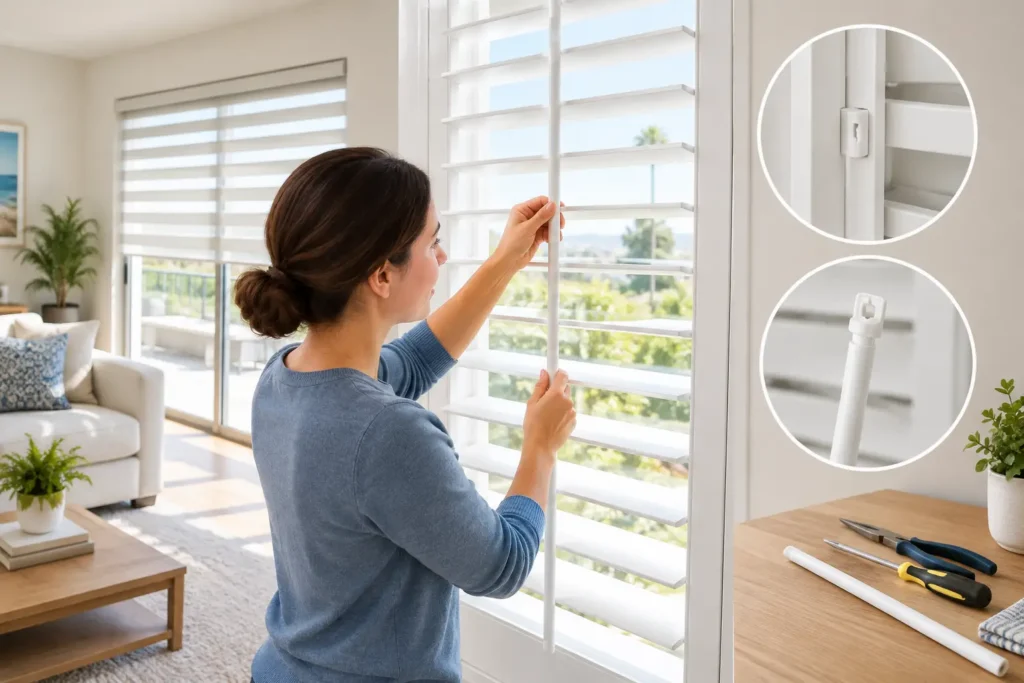
A tilt rod that has come loose usually makes itself known right away: one or two louvers stay put while the rest of the shutter opens, or the rod hangs away from the panel. The good news is that many homeowners can fix plantation shutter tilt rods without replacing the whole shutter. The key is finding the actual failed part before forcing anything back into place.
On most traditional plantation shutters, the tilt rod is the vertical bar on the front of the louvers. Small staples or connectors link that rod to each louver, so moving the rod opens and closes the entire row. A rod problem may look dramatic, but it is often a small hardware issue.
Start by finding what came loose
Open the louvers about halfway and look closely at every connection between the tilt rod and the louvers. Do not pull hard on the rod yet. You are looking for a missing staple, a staple that has pulled out of the louver, a bent connector, or a cracked section of the rod itself.
If the tilt rod is detached from just one louver, the repair is usually straightforward. If several connections have failed, the shutter may have been forced, the panel may be out of alignment, or the louvers may be too tight in the frame. In that case, replacing one staple may solve the immediate problem without addressing why it happened.
Also check whether the louvers themselves move smoothly by hand. A louver that is hard to rotate can put extra stress on the tilt rod every time someone opens or closes the shutters. This is common after a move, when a child or pet has pulled on the louvers, or when a panel has settled slightly over time.
Know the difference between a tilt rod issue and a tension issue
A loose tilt rod and loose louvers are different problems. When the louvers drift down or will not stay in the position you set, their tension may need adjustment. Many shutters have small tension screws along the side of the panel. Tightening those screws slightly can help the louvers hold their position.
Do not tighten every screw all at once. Turn one screw a small amount, test the louver, and stop when it has enough resistance. Over-tightening can make the louvers difficult to move and can cause more strain on the tilt rod connectors.
What you may need for a simple repair
For one loose connection, you may only need a replacement shutter staple or connector, needle-nose pliers, and a small flat tool to help guide the hardware into place. The exact part depends on the shutter style. Wood, composite, vinyl, and older shutters often use different staple sizes and shapes.
Before ordering or installing a part, measure the old staple if it is still available. Take note of its width, leg length, finish, and the size of the louver where it fits. A staple that is too wide can crack the louver. One that is too loose may pop out again.
If the original staple is still firmly seated in the louver but has slipped out of the tilt rod, it may simply need to be snapped or guided back into its opening. Align the rod with the staple rather than bending the staple toward the rod. Bending the connector repeatedly weakens it.
How to fix a tilt rod that popped off one louver
First, position the loose louver so it matches the angle of the louvers around it. Then line up the opening in the tilt rod with the staple or connector on that louver. Use gentle, even pressure to press the rod back onto the connection.
You should feel the rod settle into place without excessive force. Test the repair by moving the tilt rod slowly through its full range. Watch the repaired point while you do this. If the rod pops off immediately, the connector may be worn, bent, or too loose to hold reliably.
Avoid using household glue as the first fix. Glue can seep into the moving joint and keep the louver from rotating properly. It can also make a later repair harder. Glue may be appropriate in a limited repair involving a cracked wood component, but it is not a substitute for the correct shutter hardware.
Replacing a missing or damaged staple
If the staple is missing or broken, remove any remaining pieces carefully. This is where patience matters. Prying aggressively can chip paint, split wood, or damage composite louvers.
Install the replacement hardware in the same location and orientation as the original. It needs to sit straight so the tilt rod travels evenly. On a wood louver with an enlarged or damaged hole, a repair may require filling and redrilling the area before installing the correct connector. That is often better handled by a shutter repair professional, especially on a visible front louver.
Once the new staple is installed, reconnect the tilt rod and operate the panel several times. The louvers should move together with no binding, skipping, or clicking. If one louver lags behind the others, check that it is aligned and that its tension is similar to the adjacent louvers.
When the tilt rod itself needs replacement
Sometimes the rod is the damaged part. Wood tilt rods can crack near a connector hole, especially if the rod was pulled sideways. Plastic or composite rods can become brittle with age or break at a narrow point. A warped rod may also keep the louvers from operating evenly.
Replacing a tilt rod is more involved because each connector must be released and reattached in the correct order. It is possible as a DIY project when the panel is accessible and all of the hardware is intact. Still, take photos before removing anything and work one connection at a time when possible.
A replacement rod must match the panel height, width, profile, color, and connection spacing. A close-looking part can still fit poorly if the staple locations do not line up. For painted shutters, a repair that is mechanically sound can still stand out if the color match is off.
Be careful with hidden-tilt shutters
Not all plantation shutters have a front tilt rod. Hidden-tilt shutters use a mechanism along the back or side of the louvers, leaving the shutter face clean and uncluttered. If your shutters have no visible vertical rod, do not try to force the louvers into sync from the front.
A hidden-tilt problem can involve a damaged pin, connector, or internal linkage. These repairs often require removing the panel or working in a tight space. The right repair depends on the shutter manufacturer and the style of hidden mechanism, so a quick inspection can prevent damage to multiple louvers.
Signs that repair is better than replacement
A broken tilt rod does not usually mean the entire shutter panel is done for. Repair is often the practical choice when the frame, louvers, hinges, and panel are otherwise in good shape. Replacing a connector, tightening louver tension, or installing a new tilt rod can restore normal use without changing the rest of the window treatment.
Replacement starts to make more sense when there are repeated broken louvers, major warping, water damage, several cracked parts, or discontinued materials that cannot be matched. It also depends on what matters most to you. A minor repair on a guest-room shutter may be all you need, while a highly visible living-room panel may call for a cleaner long-term solution.
Keep the repair from happening again
Operate shutters by moving the tilt rod or by gently moving a louver near the center, not by grabbing the edge of one louver and forcing the rest to follow. Keep children from hanging on the rods, and avoid slamming panels into the frame.
For regular care, dust the louvers with a soft cloth or a vacuum brush attachment. Use a lightly damp cloth only when needed, then dry the surface. Too much water around wood shutters can affect the finish and hardware over time.
If your rod keeps disconnecting, the louvers are stiff, or you are unsure which replacement part fits, it is worth getting another set of eyes on the panel before a small problem becomes a broken louver. Shutters Up 360 repairs shutter panels and supplies replacement parts for homeowners throughout California. For help with a repair or a free in-home quote for new shutters, book at shuttersup360.com or call or text (916) 595-1657.